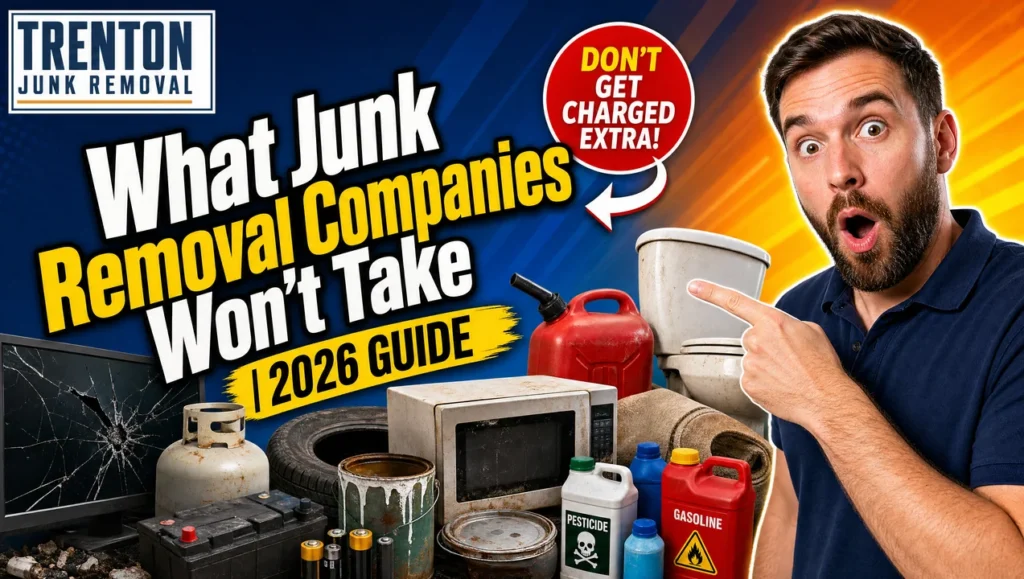
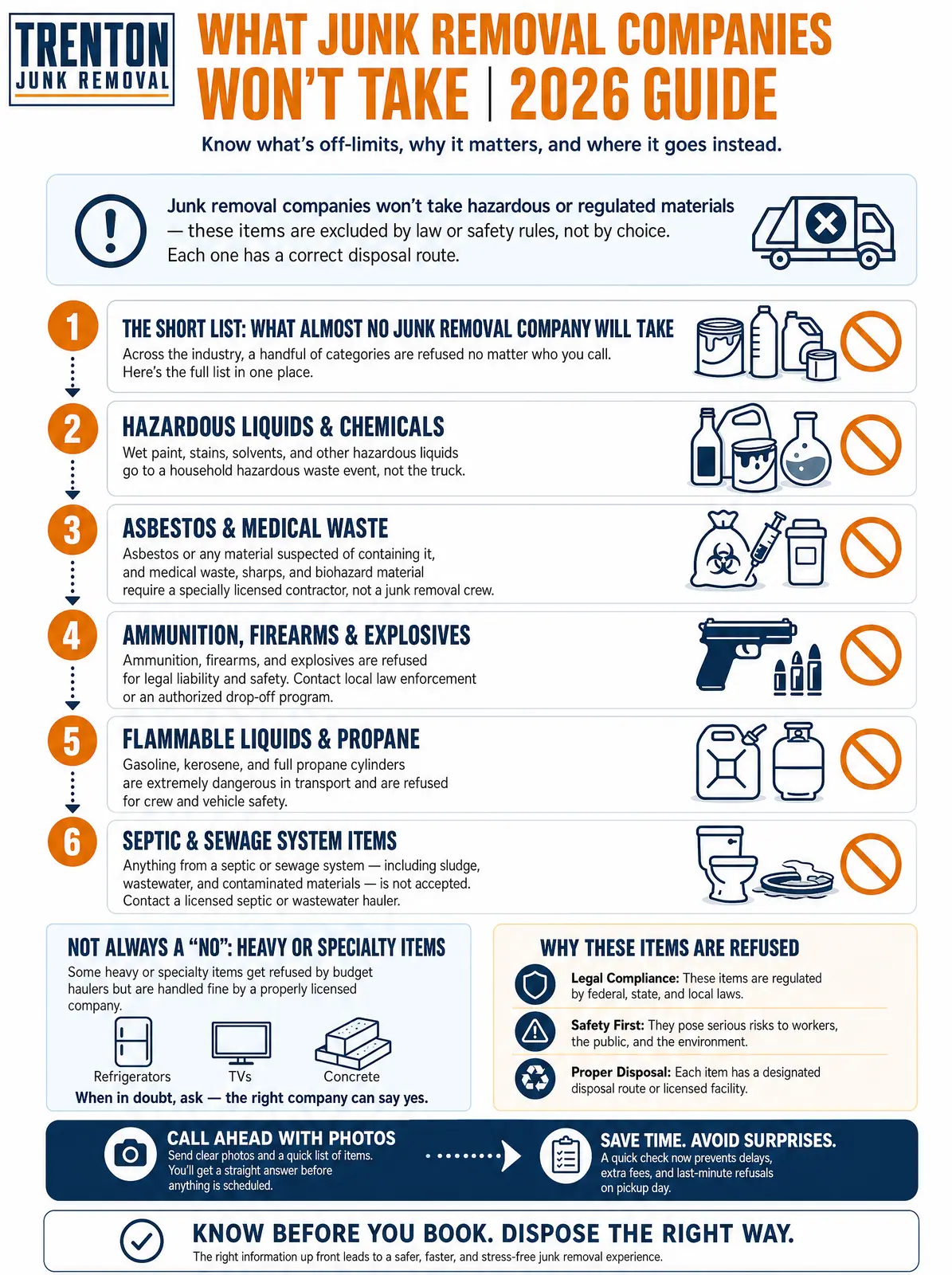
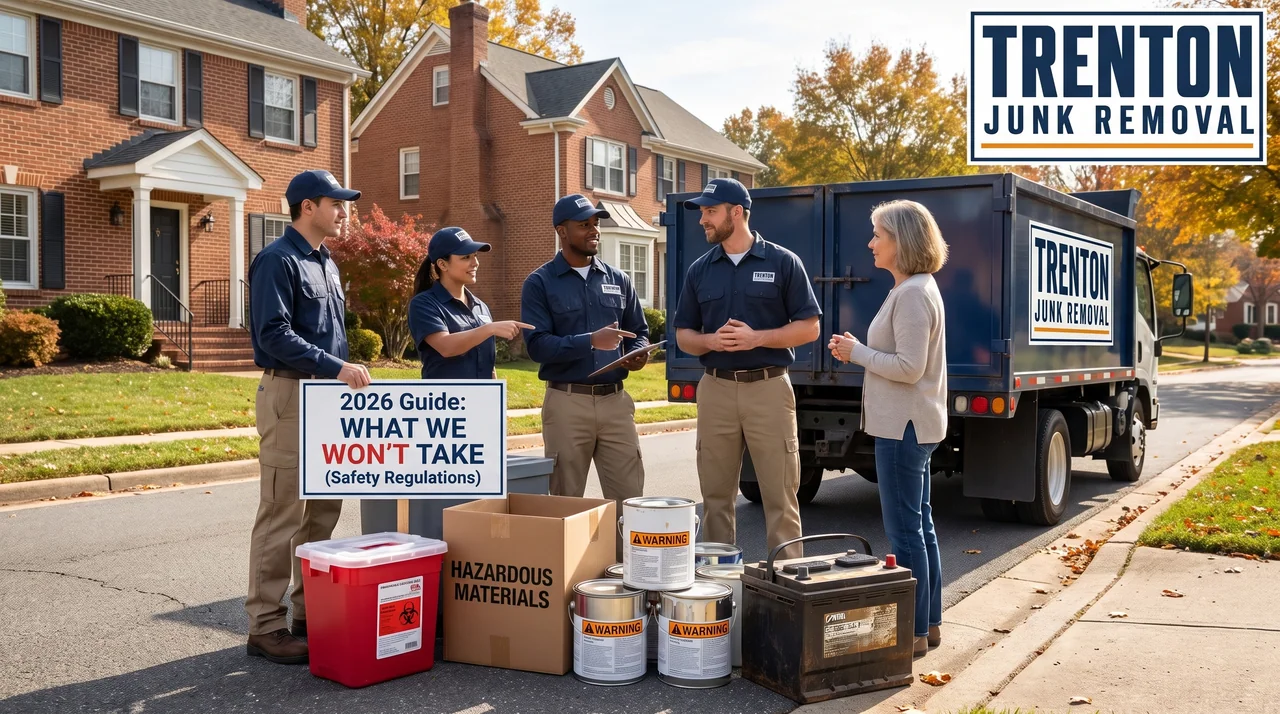
Junk removal companies won’t take hazardous or regulated materials — wet paint and chemicals, asbestos, medical waste and sharps, ammunition and firearms, flammable liquids and full propane tanks, and anything from a septic or sewage system. These items aren’t refused by choice. They’re excluded by law or by safety rules that apply to every licensed hauler, and each one has a correct disposal route.
Hazardous liquids and chemicals go to a household hazardous waste event, not the truck.
Asbestos and medical waste require a specially licensed contractor, not a junk removal crew.
Flammable fuels and full propane cylinders are refused for crew and vehicle safety.
Some heavy or specialty items — refrigerators, TVs, concrete — get refused by budget haulers but are handled fine by a properly licensed company.
Calling ahead with photos gets you a straight answer before anything is scheduled.
The Short List: What Almost No Junk Removal Company Will Take
Across the industry, a handful of categories are refused no matter who you call. Here’s the full list in one place.
Wet paint, stains, solvents, and other hazardous liquids
Asbestos or any material suspected of containing it
Medical waste, sharps, and biohazard material
Ammunition, firearms, and explosives
Gasoline, kerosene, and full propane cylinders
Anything from a septic or sewage system
Specifics vary slightly by company and by state, but these six categories are refused industry-wide for the same underlying reasons.
Why These Items Are Off-Limits
Every item on the refused list falls into one of three buckets. Understanding the pattern makes it easy to guess how any new item will be treated, without needing to memorize a full list.
Reason for Exclusion
What It Means
Example Materials
Illegal in general waste
Cannot legally go in a truck bound for a transfer station or landfill
Wet paint, chemicals, TVs in New Jersey
Requires a specially licensed hauler
Only a certified contractor is legally allowed to remove and transport it
Asbestos, medical waste, septic waste
Safety hazard to the crew or truck
Flammable, explosive, or otherwise dangerous to carry
Gasoline, ammunition, full propane tanks
Hazardous Household Materials
Household hazardous waste is the single most common reason a junk removal company says no. It covers anything flammable, corrosive, toxic, or reactive that would contaminate a landfill or a standard waste stream if it went in with everything else.
Paint, Stains, and Solvents
Wet paint, oil-based stains, and solvents are refused as household hazardous waste. There’s a practical exception worth knowing: fully hardened latex paint — dried out with kitty litter or a paint hardener — can go in your regular household trash. Wet paint and solvents cannot. Those need to go to a county household hazardous waste collection event. Confirm the current schedule and location before you plan a drop-off, since these events run on a limited calendar.
Pesticides, Pool Chemicals, Motor Oil, and Antifreeze
These fall into the same household hazardous waste category as paint. Pesticides, pool chemicals, motor oil, and antifreeze all need to go to an HHW collection event rather than into a junk truck. None of these get an exception the way dried paint does — they stay liquid and stay hazardous.
Gasoline, Kerosene, and Propane Tanks
Flammable liquids like gasoline and kerosene are refused for safety, and so is a full propane cylinder. Fuels belong at a household hazardous waste event, and full cylinders are best handled through a propane exchange program. The important distinction here is empty versus full: an empty propane or oil tank can often be removed by a junk removal company, since the hazard is gone once the tank is purged. A full tank cannot.
Regulated and Licensed-Only Materials
A second group of items isn’t dangerous in the same way paint or gasoline is — it’s regulated. A junk removal crew, even a fully insured one, is not legally permitted to handle these categories. Only a contractor with the specific license for that material can.
Asbestos and Suspected Asbestos
Asbestos removal requires a certified abatement contractor, not a junk hauler. A responsible crew stops work the moment asbestos is suspected — that’s a safety rule, not a pricing decision. Older insulation, certain floor tiles, and pipe wrap are the most common places it turns up in homes built before the 1980s, so it’s worth flagging to your hauler before a basement or attic job starts.
Medical Waste, Sharps, and Biohazard
Needles, medications, biohazard material, and anything involving bodily fluids require a licensed medical waste transporter. For household sharps specifically, a pharmacy take-back program or a local sharps disposal program is the correct route — not the curb, and not a junk removal truck.
Ammunition, Firearms, and Explosives
Ammunition, firearms, flares, and explosives are illegal to transport through a standard hauling service. These go to your local police department, which has a process for safe surrender and disposal.
Septic and Sewage Waste
Anything originating from a septic system or sewage line requires a licensed septic contractor. This one is straightforward: no general hauler, however well-equipped, is licensed to move it.
Items That Are “Won’t Take” for Some Companies but Fine for Others
Beyond the universally banned list, there’s a second tier of items that get refused or quietly upcharged by some companies but handled without issue by a properly licensed, fully equipped hauler. This is where it pays to ask before you assume something is off-limits.
Appliances with Refrigerant (Fridges, Freezers, AC Units)
Some haulers refuse refrigerators, freezers, and AC units because refrigerant has to be recovered by law before the unit can be scrapped. A properly equipped company takes them without a problem — a single appliance removal trenton nj job is priced separately for exactly this reason, not as a penalty but because the refrigerant-recovery step is real, added handling.
Televisions and Electronics (E-Waste)
Many haulers won’t put a TV in the truck at all, because several states — New Jersey included — ban TVs and electronics from household trash. They have to be routed to certified e-waste recycling instead of a landfill. A licensed local company handles that routing for you as part of the job, so the TV doesn’t become your problem after pickup.
Tires, Mattresses, and Other “Special Handling” Items
Tires and mattresses are frequently refused or surcharged by budget haulers, because disposal facilities charge special handling fees for both. Full-service companies take them routinely — mattress disposal trenton nj is one of the most common single-item jobs there is. The pattern to notice: it’s not that these items are dangerous, it’s that they cost the hauler more at the disposal end, and not every company builds that into their price list.
Heavy Materials: Brick, Concrete, and Dirt
Standard junk trucks often refuse brick, concrete, and dirt because these materials hit legal weight limits long before they fill the available space, and disposal facilities charge by the ton rather than by volume. A hauler equipped for it will take concrete and dirt removal trenton nj jobs, but prices them separately from the standard load chart, because the cost driver is weight, not room in the truck.
How to Find Out What Your Local Company Actually Takes
The fastest way to avoid a refused item on job day is to ask before you book, not after the crew arrives.
Check the company’s published list of accepted and excluded items before you call.
Send photos of anything you’re unsure about — a real hauler can give you a straight answer from the picture, not a guess.
Ask specifically about refrigerant appliances, TVs, tires, and heavy materials, since these are the categories that vary most between companies.
Get the answer in writing along with your price, so nothing gets turned away at the curb.
A licensed, NJDEP-registered local hauler serving Trenton and Mercer County can typically confirm from photos alone what’s in scope for your job and what isn’t, before a truck is ever dispatched. That’s the whole point of asking early — it turns a maybe into a scheduled job.
Not sure if something on your list is a yes or a no? Send a few photos to Trenton Junk Removal and get a straight, written answer — call (609) 237-2763 or check the what junk removal companies won’t take page for our exact accepted and excluded items list.
Frequently Asked Questions
Will junk removal take paint?
Wet paint is refused as household hazardous waste. Fully hardened latex paint — dried with kitty litter or a paint hardener — can go in your regular household trash. Wet paint and solvents need to go to a county household hazardous waste event instead.
Do junk removal companies take refrigerators?
Yes, a properly equipped and licensed company does. Refrigerant has to be recovered by law before a fridge or freezer can be scrapped, which is why they’re usually priced separately from a standard load. Some budget haulers refuse them entirely for this reason.
Can junk removal take a TV?
Yes, but it has to be routed to certified e-waste recycling, because New Jersey bans TVs and other electronics from household trash. Not every hauler is set up to handle that routing, so it’s worth confirming before you book.
Why won’t they take asbestos?
Asbestos requires a state-certified abatement contractor and can’t legally be handled by a standard junk removal crew. A responsible crew stops work the moment asbestos is suspected, rather than continuing and hoping it isn’t.
What do I do with old propane tanks or gasoline?
Full propane cylinders and fuels like gasoline or kerosene are refused for safety. Use a propane exchange program for cylinders and a household hazardous waste event for fuels. An empty propane or oil tank, on the other hand, can usually be removed by a junk removal company.
Do junk removal companies take mattresses and tires?
Full-service companies do, though some budget haulers refuse or surcharge them because disposal facilities charge special handling fees for both. Confirm the item and the price up front so there’s no surprise on job day.
Where does hazardous waste actually go?
Household hazardous waste — paint, chemicals, pesticides, motor oil — goes to a county household hazardous waste collection event. Check your county’s current schedule before you plan a drop-off, since these events run on a limited calendar.
Knowing what’s off the table makes the rest of the job simpler. If you’re clearing a garage cleanout trenton nj or a full basement, the items you can’t send to the transfer station are usually a small fraction of the pile — everything else, from furniture to appliances to construction debris, can go out the same day. See the full junk removal prices trenton nj list or reach out through Trenton Junk Removal with photos of what needs to go, and get a written answer back before anything is scheduled.
Tom Brennan is the owner of Trenton Junk Removal, a family-run hauling operation in Trenton, NJ. He founded the company, approves every special quote personally, and set the written-price standard that put the full load chart — $175 for an eighth of a truck, $695 for a full one — on the website.