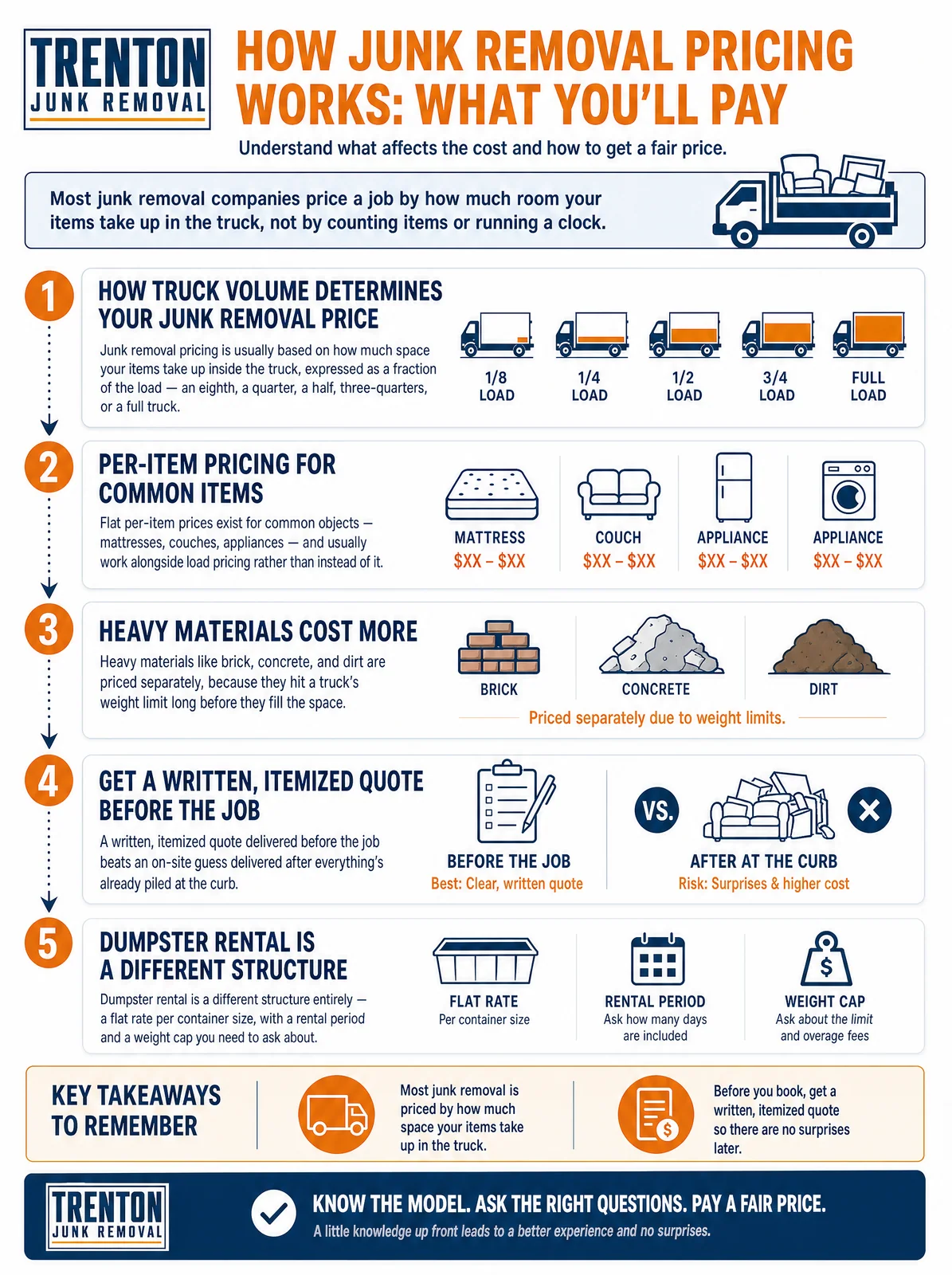
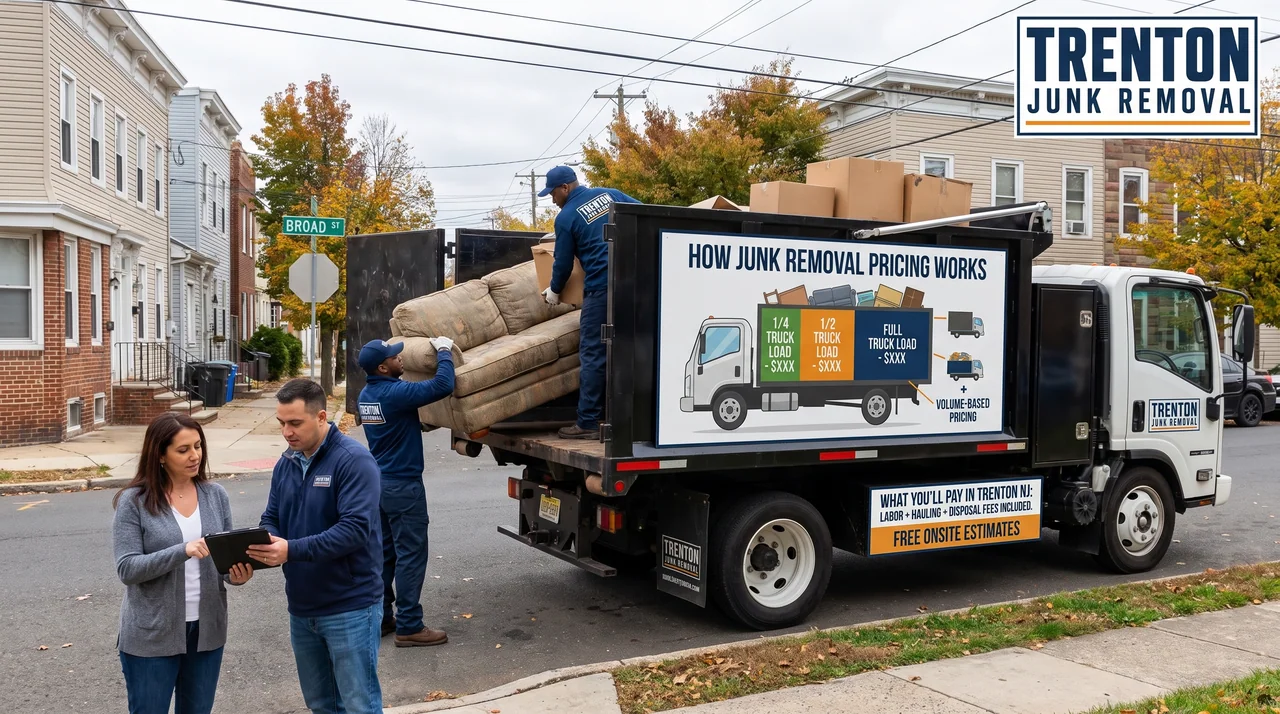
Most junk removal companies price a job by how much room your items take up in the truck, not by counting items or running a clock. A job gets measured in fractions of a truck bed — an eighth, a quarter, a half, three-quarters, or a full load — and then extra charges get added on top for heavy materials, distance, or how you pay. The part that actually varies most between companies isn’t the pricing model. It’s when you find out the number: before the crew shows up, or after.
What to know before you call anyone:
Most junk removal pricing is based on truck volume (load fractions), not item count or time on the clock.
Flat per-item prices exist for common objects — mattresses, couches, appliances — and usually work alongside load pricing rather than instead of it.
Heavy materials like brick, concrete, and dirt are priced separately, because they hit a truck’s weight limit long before they fill the space.
A written, itemized quote delivered before the job beats an on-site guess delivered after everything’s already piled at the curb.
Dumpster rental is a different structure entirely — a flat rate per container size, with a rental period and a weight cap you need to ask about.
How Truck Volume Determines Your Junk Removal Price
Junk removal pricing is usually based on how much space your items take up inside the truck, expressed as a fraction of the load — an eighth, a quarter, a half, three-quarters, or a full truck. This is the model used by most national franchises and local haulers alike, because truck space is the resource that runs out first on a typical household job.
Two large items — a mattress and box spring, or a small couch and loveseat
1/4 truck
$275
A single room’s worth, or a garage corner
1/2 truck
$395
A bedroom or a packed garage
3/4 truck
$525
A basement or a large garage
Full truck
$695
A full apartment or a finished basement
What Each Load Size Typically Holds
The easiest way to estimate your own job is to picture the space, not the item count. An eighth of a truck is roughly two large pieces of furniture. A half truck usually clears a single bedroom or a fully packed garage. A full truck matches a small apartment or a basement cleanout trenton nj that’s been used for storage for years. If you’re staring at a two-car garage that hasn’t been touched since a move, you’re likely looking at a 3/4 or full load, not an eighth — see the garage cleanout trenton nj examples for a size comparison before you call.
Why Space Matters More Than Item Count or Weight (Usually)
Truck space is the scarce resource on most household jobs, so pricing follows space rather than the number of boxes or bags involved. Ten light items in loose bags might fill the same eighth as two bulky pieces of furniture. The exception is dense material — brick, concrete, dirt, roofing — which can hit a truck’s legal weight limit long before it fills the available space. Those materials get priced differently, and the section below explains exactly why.
Other Ways Companies Price a Job
Truck-volume pricing is the default, but it’s not the only model in the category. Knowing the alternatives helps you compare quotes that look structured completely differently.
Flat Per-Item Pricing
Many companies keep a fixed internal price for common objects regardless of what else is in the truck — a mattress, a single refrigerator, a couch, or a piano each carry a set rate. This works alongside load pricing rather than replacing it: the item usually counts toward whichever load fraction it falls into, and whichever number is higher — the item price or the load fraction — is typically what applies. It’s why mattress disposal trenton nj, furniture removal trenton nj, appliance removal trenton nj, and piano removal trenton nj often show up as their own line items on a published chart instead of being folded into a generic load price.
Hourly or Labor-Based Pricing
Hourly pricing shows up on jobs that are mostly labor rather than mostly volume — heavy demolition-adjacent work, unusual access, or a job where nobody can predict how long the carry will take until a crew is on site. It’s less common for standard household junk because it’s harder for a customer to predict the final number in advance, which runs against the entire point of comparing quotes before booking.
Dumpster Rental as an Alternative Model
Roll-off dumpster rental works on a completely different structure: a flat rental price per container size, for a set rental period, with a weight or tonnage allowance included. Example sizes and prices, like the ones listed under dumpster rental trenton nj, typically run in tiers — a 20-yard, a 30-yard, and a 40-yard container. The two fees most often overlooked on a dumpster contract are the tonnage cap and the overage rate charged per ton past that cap — ask about both before you sign.
Cheaper per job, but you load it yourself over days
Full-service haul (truck volume)
Anyone who wants it gone the same day
Priced by volume, crew does all the lifting
The Add-On Fees That Show Up on Your Bill
The base load price or item price is rarely the whole story. Most companies add a short list of surcharges on top, and whether those get disclosed up front or discovered on job day is the real difference between a good experience and a bad one.
Heavy Material Surcharges (Brick, Concrete, Dirt, Roofing)
Dense materials get priced above the standard load chart because they hit a truck’s legal weight limit long before they fill the available space, and disposal for these materials is billed by the ton at the transfer station. That’s why concrete and dirt removal trenton nj and similar heavy-debris jobs carry their own rate rather than sliding into the regular chart. If a company can explain this mechanism clearly instead of just quoting a bigger number, that’s a decent sign they’re not padding the bill.
Travel or Trip Fees
Companies with a set service radius often charge a distance-based fee once a job falls outside their core zone, usually tiered by mileage — no charge close in, a modest fee at a middle distance, and a higher fee at the outer edge. A job in a close-in town like junk removal hamilton nj often sits in the no-fee tier, while a farther town like junk removal princeton nj may fall into a higher tier. Ask which tier your town falls into before you book, not after.
Card and Payment Processing Fees
Some companies add a percentage — commonly around 3% — for credit or debit payments to cover what the payment processor charges, while cash or check gets the listed price. This is one of the most-complained-about surprise fees in the category, mostly because it tends to appear for the first time on the invoice. Confirm the payment-method fee before the crew arrives, not after the truck is loaded.
Stairs, Long Carry, and Floor-Level Fees
Policies vary widely here. Some companies charge extra for hauling out of an upper floor, a long carry from the back of a property, or a basement pickup; others build it into the standard price. This is worth asking directly, because it’s one of the easiest ways to compare two otherwise similar quotes.
Ask whether the price includes stairs and long carries, or whether that’s billed separately.
Ask whether heavy materials are priced from the standard chart or a separate rate.
Ask what the card-payment fee is, if any, before you commit.
Ask whether the travel fee applies to your specific town, not a general service area.
Why Almost Every Company Has a Minimum Charge
A minimum job charge — often somewhere around $175 — covers the truck, the crew, and the disposal fee whether the job is a single item or a full eighth of a load. Because you’re paying that minimum either way, adding a few more items up to that first load fraction frequently costs nothing extra. If you’re already paying for the truck to show up, it’s worth a quick second look around the house before the crew leaves.
On-Site Estimates vs. Photo-Based Quotes: Why the Order Matters
There are two ways a price actually reaches you, and the order matters more than almost anything else in this category. The traditional model has a crew estimate the job standing in your driveway — usually after you’ve already hauled everything down from the attic or out to the curb, which makes saying no to a bad number more expensive than saying yes. The newer model quotes the job from photos before a truck is ever dispatched, so you can compare it against another company without having done any of the labor yet. For a deeper look at how that sequence works in practice, see how junk removal pricing works from the sourcing side.
How to Tell If a Quote Is Trustworthy
Check whether the price is itemized, not a single lump number.
Confirm every surcharge — travel, heavy material, card processing — is named as its own line, not folded into the total.
Get it in writing before the job is scheduled, not verbally on the day.
Look for a company that publishes its chart publicly rather than requiring a call for a number.
Ask directly whether the mattress fee, stair policy, and card fee are already included in what you’re seeing.
The Volume Discount: Why a Bigger Load Costs Less Per Item
Per unit of space, a full truck is usually far cheaper than an eighth, because the fixed costs of the trip — the truck, the crew, the drive — get spread across more volume. Using the example chart above, an eighth truck at $175 works out to $175 per eighth, while a full truck at $695 works out to roughly $81 per eighth — meaningfully less per unit of space. The practical takeaway: if you’re on the fence about clearing one corner of the garage versus the whole thing, clearing the whole thing at once is usually the better math, not just the more thorough job.
How to Estimate Your Own Junk Removal Cost
Group everything you want removed into one area and picture what fraction of a truck bed it would fill — an eighth, a quarter, a half, and so on.
Flag anything unusual separately: a piano, a single refrigerator, a hot tub, a TV, or any brick, concrete, or dirt.
Check whether your town falls inside a company’s free local radius or triggers a travel fee.
Ask for a written, itemized quote and confirm the payment-method fee before you book a date.
Compare the full total — base price plus every add-on — rather than just the headline number two companies text you.
When Free Municipal Pickup Is Enough — and When It Isn’t
Many cities offer a limited free bulk-item pickup by appointment, usually capped at a small number of items per visit. Trenton’s Division of Solid Waste Management runs a bulk pickup program by appointment, capped at a set number of furniture items per appointment. That cap is exactly the point where a paid hauler becomes worth it — a full room, a garage, an eviction, or an entire house exceeds it fast. Anything that falls outside what municipal pickup covers, or anything the city won’t take at all, is worth checking against a list like what junk removal companies won’t take before you assume a hauler can handle it.
A Quick Word on Getting a Written Price in Trenton
Trenton Junk Removal publishes its full price chart and quotes jobs from photos before scheduling, so anyone in the Trenton or Mercer County area can see an itemized written price before a truck is ever dispatched. That applies to standard cleanouts as well as heavier jobs like construction debris removal trenton nj, where knowing the heavy-material rate ahead of time actually matters. You can read more on the Trenton Junk Removal homepage or learn more about the crew on the about trenton junk removal page.
Want a real number before anyone shows up at your door? Send a few photos and get an itemized written price back — call (609) 237-2763.
Frequently Asked Questions
How is junk removal priced — by weight, by item, or by volume?
Most companies price by truck volume, using load fractions like an eighth, a quarter, a half, and a full truck, with flat per-item prices for common objects and separate rates for heavy materials that get billed by weight.
What does a half truck load of junk typically cost?
A half truck typically clears a bedroom or a packed garage, and often runs in the $350–$400 range on a published chart, though the actual price varies by company and region.
Why do companies charge extra for concrete, brick, or dirt?
Dense materials hit a truck’s legal weight limit long before they fill the available space, and the transfer station bills disposal by the ton — so these materials carry a rate above the standard load chart.
Is there usually a minimum charge for junk removal?
Yes — most companies charge a minimum that covers the truck, the crew, and the disposal fee whether the job is one item or a small load, often somewhere around $175.
Do junk removal companies charge for stairs or long carries?
Policies vary — some companies include stairs and long carries in the standard price, while others add a separate fee, so it’s worth asking directly before you book.
Should I rent a dumpster or hire a full-service hauler?
Rent a dumpster if you’d rather load it yourself over several days and save on labor cost; hire a full-service hauler priced by truck volume if you want the job done and gone the same day.
How can I avoid surprise fees on a junk removal bill?
Ask for a written, itemized quote before the job that names every surcharge separately — travel, heavy material, and card processing — so nothing new appears on the invoice after the truck is loaded.
Is it cheaper to remove everything at once or in small loads?
Removing everything at once is usually cheaper per unit of space, because the fixed costs of the truck, crew, and trip get spread across a larger load instead of being paid again for each small pickup.
Tom Brennan is the owner of Trenton Junk Removal, a family-run hauling operation in Trenton, NJ. He founded the company, approves every special quote personally, and set the written-price standard that put the full load chart — $175 for an eighth of a truck, $695 for a full one — on the website.