
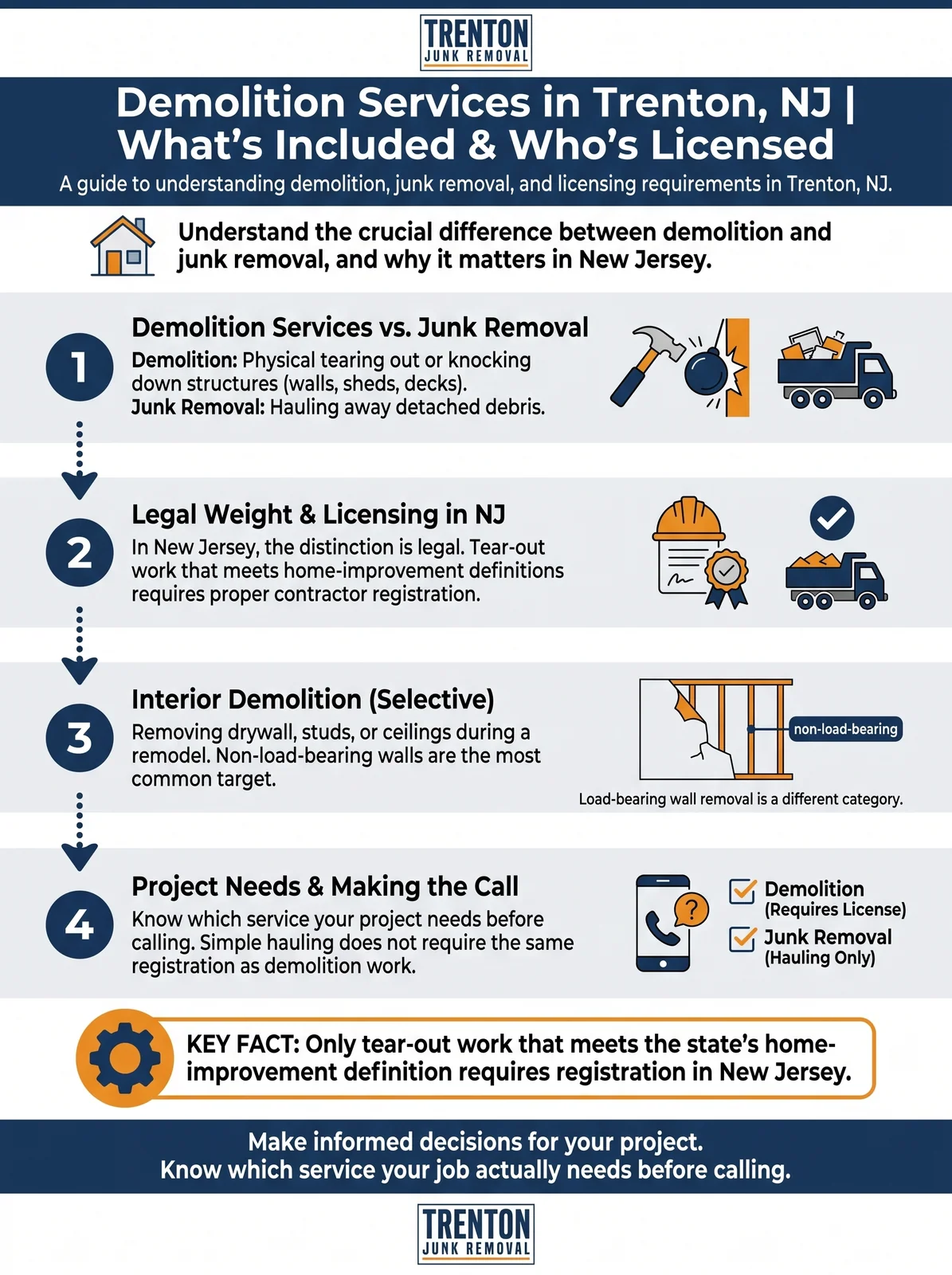
Trenton Junk Removal fields calls asking about demolition work more often than you’d expect — including from lead-generation callers who ask whether we’re “still doing demolition service” before anything else gets discussed. Demolition services cover the physical tearing out or knocking down of a structure or fixture: interior walls, cabinets, decks, sheds, concrete slabs. Junk removal is a different job — hauling away debris that’s already detached and sitting in a pile. In New Jersey, that distinction carries legal weight. A hauling crew can load and dispose of debris all day; tear-out work that meets the state’s home-improvement definition requires proper contractor registration. This guide walks through what falls under each label, so you know which one your project actually needs before you make a call.
Demolition Services Explained: Types of Demolition Work
“Demolition” covers a wide range of jobs, from pulling a single fence to gutting an entire kitchen. Below is the full spectrum a Trenton homeowner or property manager is likely to mean by the term, and where each one typically sits — regulated tear-out, straightforward hauling, or a combination of both.
Interior Demolition (Walls, Ceilings, Non-Load-Bearing Partitions)
Interior or selective demolition means removing drywall, lath-and-plaster, studs, or a dropped ceiling during a remodel. Non-load-bearing partition walls are the most common target. Load-bearing wall removal is a different category entirely — it typically requires engineering sign-off and a permit before a single stud comes out. This is regulated home-improvement work in New Jersey. [verify licensing specifics with a registered contractor].
Kitchen & Bathroom Gut-Outs
A full gut-out removes cabinetry, countertops, backsplash tile, a vanity, and the tub or shower surround down to the subfloor. This is where demolition and cleanout genuinely overlap: the cabinets have to come out first, then the debris has to leave the property. Reference pricing in the $750–$1,500 range for cabinet and wall-demo work has been noted in local schedules [verify], and this scope falls under New Jersey’s home-improvement rules.
Concrete & Slab Removal
Breaking up a patio, walkway, driveway section, or old slab means a jackhammer or breaker, then dealing with rebar and aggregate. Concrete is priced differently from most demolition debris because it’s heavy, not bulky — it hits a truck’s weight limit long before it fills the space, which is why our concrete and dirt removal in Trenton, NJ is quoted separately from a standard load, in the $750–$900 range [verify].
Deck, Porch & Stair Demolition
Tearing out a wood or composite deck, a porch, or exterior stairs involves pressure-treated lumber, joists, and often concrete footings that anchor the posts. New Jersey’s home-improvement statute names porches specifically, which puts this scope inside regulated contractor territory rather than simple hauling [verify current statute language].
Shed & Outbuilding Demolition
Not every shed removal is a demolition job. An intact, empty metal or wood-frame shed that can be lifted or disassembled and carried out is closer to hauling. A shed anchored to a poured slab, or built into a structure, needs actual tear-out first. Knowing which one you have changes who should do the work.
Fence Removal & Demolition
Pulling wood, vinyl, or chain-link fencing sounds simple until you hit concrete-set post footings, which turn a fence job into real demolition. New Jersey’s home-improvement definition specifically names fences. Reference pricing in the $250–$300 range has appeared in local schedules [verify], and this scope is treated as regulated work, not straight hauling.
Flooring & Carpet Tear-Out
Removing wall-to-wall carpet, tack strip, tile, vinyl, and sometimes the underlayment or thinset beneath it sits in a gray area — simple carpet pull is closer to hauling, but tile and subfloor work edges toward regulated demolition. A reference add-on rate near $500 for wall-to-wall carpet has appeared in local pricing [verify]; this scope is currently on hold pending contractor registration decisions.
Hot Tub & Above-Ground Structure Demolition
Breaking down a hot tub, above-ground pool, or similar fixed installation means dealing with an acrylic shell, a decking frame, and a pump or heater unit that has to be disconnected first. Once disconnected, this often falls closer to hot tub removal in Trenton, NJ than to true demolition, depending on how it’s anchored.
Garage & Basement Clear-and-Demo
A combined job clears out contents first — boxes, old furniture, shelving — then demolishes built-ins, a drop ceiling, or a partition wall. New Jersey’s home-improvement statute names both garages and basements. The clearing portion is a basement cleanout in Trenton, NJ; the built-in demo portion is regulated contractor work.
Debris Hauling After Demolition (Post-Demo Cleanup)
Once a structure or fixture is torn out, someone still has to remove the brick, drywall, wood, and concrete left behind. This is the hauler’s lane — legally, it’s hauling, not demolition, and it’s exactly what a junk-removal company does directly. For self-load jobs, a roll-off container is often the more practical option; see our dumpster rental in Trenton, NJ sizes and rates [verify current terms].
Demolition vs. Junk Removal: How to Tell Which You Need
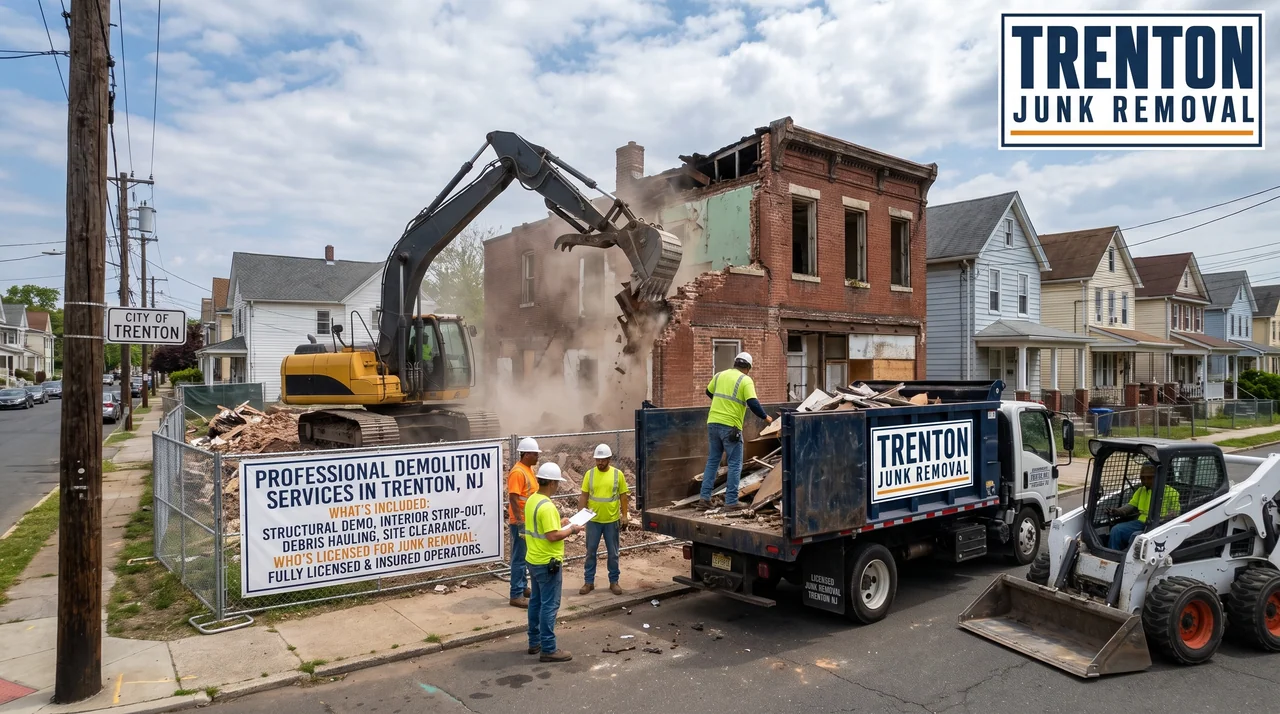
The confusion is common enough that even industry callers phone ahead to ask whether “demolition service” is something a company still offers, before anything else gets discussed. The line is simpler than it sounds once you know what to check.
| What You’re Dealing With | Likely Demolition (Registered Contractor) | Likely Junk Removal (Hauling Only) |
|---|---|---|
| A wall, cabinet, or fence still attached to the structure | Yes — tear-out is regulated work | No |
| Furniture, appliances, or debris already piled and detached | No | Yes |
| A concrete slab, patio, or driveway section still in place | Yes | No — hauling the broken pieces after is a separate job |
| A shed or hot tub that’s intact and can be lifted out whole | Sometimes — depends on anchoring | Often — if it disconnects cleanly |
| Debris left over after a contractor’s tear-out | No | Yes — this is the hauling half of the job |
If you’re not sure which column your project belongs in, our junk removal services in Trenton, NJ page breaks down each hauling-side service individually, which can help narrow down what’s left over once you know what the demolition side requires.
Do You Need a Permit for Demolition in Trenton, NJ?
Removing a non-load-bearing interior wall often requires a municipal permit, and any change to a load-bearing wall almost always does. Full-structure demolition — a shed, garage, or outbuilding coming down entirely — is typically permitted work as well. Small, non-structural tear-outs may not need one, but the only way to know for certain is to confirm directly with Trenton’s construction or building department before work starts. [verify current permit thresholds and fees with the municipality].
Send three photos. Get an itemized written price back — priced off the chart on this page, and that written price is what you pay.
Call (609) 237-2763Licensing: Who’s Legally Allowed to Do Demolition in New Jersey
New Jersey’s Home Improvement Contractor (HIC) definition explicitly includes “demolishing,” and the statute names cabinets, kitchens, fences, porches, garages, and basements among the covered categories — with no minimum project value that exempts small jobs. That means a registered HIC is the one legally positioned to perform the tear-out itself. Separately, anyone hauling and disposing of the resulting debris on someone else’s behalf needs an NJDEP A-901 waste-transport credential. These are two different licenses covering two different halves of the same project. [verify current registration numbers before hiring anyone]. This is precisely the gap a caller asking “are you still doing demolition” is often trying to find out — whether the company on the other end is set up for the tear-out, the haul, or both. Before hiring anyone for demolition work, ask directly for their HIC registration number, and ask separately who’s licensed to haul the debris away.
What Demolition Costs and What Drives the Price
Demolition pricing depends on a handful of concrete factors, not a flat per-job rate:
- Scope — a single interior wall costs far less than a full kitchen gut-out or garage demo.
- Material weight — concrete and brick are priced by the ton because they hit a truck’s weight limit before they fill its volume.
- Disposal fees — transfer stations and scrap yards charge differently depending on material type.
- Permits — permitted structural work adds municipal fees and inspection time to the schedule.
- Labor — footings, anchored fixtures, and load-bearing work all add hours beyond the basic tear-out.
Reference figures that have appeared in local pricing schedules — cabinet and wall demo at $750–$1,500, fence removal at $250–$300, concrete at $750–$900 [verify all figures before relying on them] — illustrate why demolition is quoted per job rather than off a fixed chart the way a straightforward furniture or appliance haul can be. For comparison, our own hauling-side rates are published on our junk removal prices page for Trenton, NJ.
How a Demolition-and-Cleanout Job Typically Flows
- Assess the scope and confirm whether the work is demolition, hauling, or both.
- Confirm what permits or licensing the tear-out portion requires.
- Disconnect utilities where relevant — power, water, gas lines near the work area.
- Perform the tear-out itself, following any structural or permit requirements.
- Sort the resulting debris — donation, recycling, scrap metal, and transfer-station material each route differently.
- Haul the debris out and dispose of it properly.
- Sweep the site clean before calling the job finished.
The last two steps are where a hauling crew’s standards matter most — a job isn’t finished until the debris is gone and the floor is swept, not just piled at the curb.
Not sure whether your project needs a demolition contractor, a hauling crew, or both? Send us a few photos of the space and we’ll tell you straight — including whether it’s outside our scope. Reach Trenton Junk Removal at (609) 237-2763, or start with a written price for the hauling side of the job before anyone shows up.
Frequently Asked Questions
Is demolition the same as junk removal?
No — demolition is the physical tearing out or knocking down of a structure or fixture, while junk removal is hauling away debris that’s already detached. Many projects need both, handled by two different licenses.
Does a junk removal company do demolition in Trenton?
A junk-removal or cleanout company primarily hauls and disposes of debris rather than performing structural or interior tear-out work. Structural demolition that meets New Jersey’s home-improvement definition requires a registered contractor, so it’s worth asking directly whether a company holds that registration before booking tear-out work. [verify current registration status before hiring].
Do I need a permit to demolish an interior wall in NJ?
Removing a non-load-bearing wall often requires a municipal permit, and a load-bearing change almost always does. Confirm the exact requirement with Trenton’s building department before work begins. [verify current permit rules].
How much does demolition cost?
Demolition cost depends on scope, material weight, disposal fees, permits, and labor rather than a single flat rate. Heavy material like concrete and brick is priced by the ton, not by how much space it takes up. [all reference figures verify before relying on them].
What happens to the debris after demolition?
Debris is typically sorted into donation, recycling, scrap metal, and transfer-station categories before it’s hauled away. For self-load demolition debris, a roll-off dumpster is often a practical option — see our dumpster rental in Trenton, NJ page for sizes. [verify current terms].
How do I know if a demolition contractor is licensed in New Jersey?
Ask for their New Jersey Home Improvement Contractor (HIC) registration number for the tear-out work, and separately ask who holds an NJDEP A-901 credential for hauling the debris. [verify both before hiring]. These are two different licenses covering two different parts of the job.
Can you demolish and haul away in one job?
Combined demo-and-haul jobs are common, but the tear-out portion legally needs to be performed by someone registered for that work, while the hauling portion is standard junk-removal territory. Confirming which part of the job you actually need is the first step, not the last one.